October 26, 2014

5: The Lamb Roast


Last weekend, we hosted a party that featured a thirtieth birthday bash and a whole lamb roasted on a spit. You may not want to look any further if the sight of a whole, skinned ungulate makes you squeamish. It certainly didn't to my friends, who grinned like madmen while they stuffed the beast with seasonal veggies. The only thing they were upset about was that the butcher didn't include the head!

What ensued was a whole lot of eating, dancing, live music provided by Apel and Pellz Bellz, deep frying, day drinking, roasting, and did I mention eating? Because at one point I had to excuse myself from the kitchen because the sight of food was making me queasy. Yes, I was that full. And we have a deep fryer now. What the what?? 

Off the menu: deep fried buffalo Brussels sprouts, Filipino fried rice, pulled pork collard greens, grilled mackerel, chicken and caramelized onion waffles featuring maple sriracha sauce, and oh so many deep fried treats. Oh, and of course our perfectly roasted whole lamb on a spit.

Man, city kids really get after it when you let them loose in the country for the weekend, don't they? 

One

Two

Three


Four

Five

Friends who kill it at the electric guitar certainly take jamming around the campfire to a new level!

October 24, 2014

Go: South Dakota


Feeling inspired, I thought I would add a few more chapters to my nearly vintage travel-epic, 'Go' (<-- catch up on the story by clicking on the link). Even though this adventure happened two+ years ago (my, where has the time gone?!), it gives me a chance to get all nostalgic on South Dakota whilst gazing fondly at my feline stowaway. Also, I haven't traveled in a bit, so I want to live vicariously through my former self.

To recap lightly, AGP and I have just exited Nebraska and entered South Dakota during our three month long cross-country road trip. We are on our way to the Muddy Pumpkin Farm in Oacoma where we are WWOOF-ing for a few weeks. You should probably know that at this point in time, pre-Muddy Pumpkin Zy is in LOVE with the romantic ideals and mysterious depths of the prairie. This is my second time in South Dakota. Onward, prairie schooner!


With my nerves a-tingle and still high on Nebraska, AGP and I crossed into the shadowy southern reaches of the Black Hills of South Dakota.

First stop: Wind Cave National Park, where we took a short hike to soak up some of the sights and sounds of the last largest mixed-grass prairie in the nation. And I hate to get all geo-nerd on you, but Wind Cave is cool. I wish we had longer to check out the yawning cave considered to have the most passages per volume in the world. Shit's dense, ya'll. However, we were eager to get into the heart of the Black Hills and didn't feel like hanging around to go on a guided tour. We are very independent and impatient like that. 


So we set the tent in Custer, South Dakota, at Custer's Gulch where General Custer himself once camped! We got serendipitous with another spectacular atmospheric event as we set up in rain that eventually turned to pulverizing hail. Suddenly, behind the veil, a beautiful rainbow made only more beautiful by the bright white clumps of sky ice illuminated by the sliver of sun. Of course, cameras are inept at capturing such rapture, but hopefully you can get the gist:


Even the camp host who was hanging with us was in awe!

We spent the next day touring the Black Hills in our car, checking out the Crazy Horse Memorial, Mount Rushmore, and even catching the vaguest glimpses of what we are definitely calling a mountain lion. The following day was going to be a big one; we were going to hike Harney Peak, which is not only the highest peak in South Dakota, but also the highest peak east of the Rocky Mountains! And like true mountaineers, we weren't going to take the easy way up, so we kind of wanted to lay low the day before.


The next day, we started our trek from the Willow Creek Horse Camp for the epic 5-mile up and 5-mile back hike to the summit to check out the view Sioux Medicine Man, Black Elk, called "the hoop of the world."


Then I was standing on the highest mountain of them all, and round about beneath me was the whole hoop of the world. And while I stood there I saw more than I can tell and I understood more than I saw; for I was seeing in a sacred manner the shapes of all things in the spirit, and the shape of all shapes as they must live together like one being. And I saw that the sacred hoop of my people was one of many hoops that made one circle, wide as daylight and as starlight, and in the center grew one mighty flowering tree to shelter all the children of one mother and one father. And I saw that it was holy. (Black Elk)
The journey was a challenge to say the least, especially considering AGP and I are amateur backpackers at best, but we inevitably made it to the fire lookout tower at the top and soaked in the astounding 360 degree views beyond the Black Hills, across the plains, and on and on into infinity. We of course did that thing where we slung our arms around each other happily and patted each others backs while congratulating ourselves on how strong and unique we are for having ascended the summit. Of course, the peak was swarming with tourists in flip flops since there is a shorter hike from a closer campground, but we just ignored those fools.


Once we dragged ourselves back to the bottom, we headed up to Deadwood, South Dakota, to check out a little history and drink a little beer before making a last second camp decision at the Rush No More Campground in Sturgis. And even though we had to camp on an incline in the "tenting field", they had a live band playing cowboy music and a wildly unexpected hot tub, which felt absolutely luxurious to our tired bodies.


Come the next morn, it was time to bring AGP to my beloved Badlands National Park. Having been brought to tears my first time through, I was eager to recreate some of the same stunning moments with my love.


We circumnavigated the park, dually admiring buffalo roaming in the hundreds under the lemon sun and watching lightning strike the dusty valleys until we got down at the blessedly free Sage Creek Campground. Thankfully, we arrived on the early side because the campground field quickly became crowded with campers. And buffalo.


Since we had already done a big hike through the Nebraskan Badlands at Toadstool Geologic Park and were still a bit achy from peak-bagging Harney, we opted for the more scenic interpretation of the park via car window before heading west towards central South Dakota, where we were a-twitter with excitement for our first experience WWOOF-ing which for those unaware is a program that pairs volunteers with needy organic farms.


We just had one more day until we were due, so we skipped our way down the Recreational Areas of the mighty Missouri River's eastern banks until we found a campground that was able to accommodate us for the Father's Day weekend.


We made a hasty camp while looking nervously forward towards the upcoming agricultural obligations in our new life as farm volunteers. We had agreed to stay and help out for at least two weeks and for a pair of people who had just spent the last month zooming around the country, two weeks in one place suddenly seems to loom statically.


I can remember climbing back up the Missouri the next day through windy grain fields with anxiety blossoming in my gut. Perhaps I had been romanticizing the prairie all these years, I worried, and maybe this was a little too out there - even for me. The beautiful fields that used to placate now inspired nervousness as they whipped in the relentless winds. Gray clouds crawled into the sky and the quaint prairie towns took on an unattractive, gritty quality. An empty quality. We stood in a grocery store on the outskirts of Oacoma, South Dakota, and guessed helplessly at the supplies we might need and hopelessly at the stark options. Even though we were in the right town, the directions still said we had thirty minutes to go and adopted prominent landscape features as turn guidance instead of street names. And it was HOT. Draped over I-90, the landscape gave the suggestion that all we were going to find at the end of these directions was a gnarly old farmer man and arid, windswept fields.
 
Well, we were mostly right. Stay tuned.

(I have decided to forgo including a map because Google Maps is making it hard for me to customize the winding journey we took through western S. Dakota. Maybe I will try Roadtrippers.com...)

October 21, 2014

On Arches and the World's Oldest Living Organism


Catch up on the adventure here (Oklahoma to New Mexico) and here (Adventure in the Jemez Mountains).


I could go on and on about my indefatigable love for prominent monolith Shiprock - my beloved winged rock, my pointy volcanic neck - and its cultural, mythological, and geologic significance, but I've done that before. All you need to know is that I am in love with Shiprock, perpetually drawn to its starry beacon of radiating dikes. Even the name falling from my lips makes me wistful: Shiprock.


And, true to its name, it does indeed look like a mammoth sail set on the vast desert sea. Because it is protected as a spiritual and cultural epicenter for the Navajo, access is limited to the closest public roads which greatly hinders its geological magnetism. Even though I am pulled cross country to catch a glimpse of it time and time again, I am left to circumnavigate it endlessly without ever getting any closer.


After staring longingly at Shiprock for a while, we headed for Four Corners so Nessa could get her traveling chops and so I could get called a showoff for doing a handstand on four states at once. Yea, like I was really the first to do that!


Hooray for being in four states at once! Before long we found ourselves headed north to Moab and Arches National Park like dutiful tourists, checking off all the traditional sights and sounds of a southwestern road trip. Then a really cool thing happened: We are driving up US-191 with the windows down and the satellite radio blasting, being warmed by the late afternoon sun and trying to find Drake on every channel, when we found ourselves five miles out of Blanding, Utah. Suddenly, the air wasn't quite so warm anymore and we watched with alarm as the thermometer rapidly dropped fifteen degrees. Before we could even hypothesize what was happening, we happened upon an apocalyptic scene: gray clouds blotted out the sun and all around us, the telltale signs of a massive hail storm. Remember, this is on a sunny day in mid September just shy of Moab, but what do we see? Ice, everywhere, covering the road, fields, and yards in a thick blanket of wintery white. And just as soon as we entered it, it was gone - back to the sunbaked Utah highway and its endless blue sky. A bit of unearthliness in an already unearthly world.


We didn't have grand plans for the evening. Our only goals were to find easy camp before sunset, take a hopefully beautiful stroll in the shadow of Mt. Peale, eat barbecue food and drink beer. We got lucky on all three accounts with an added light show in the form of encroaching thunderstorms up the Spanish Valley while wasting away another Utah weekday night with wine and conversation. Typical road trip scenario


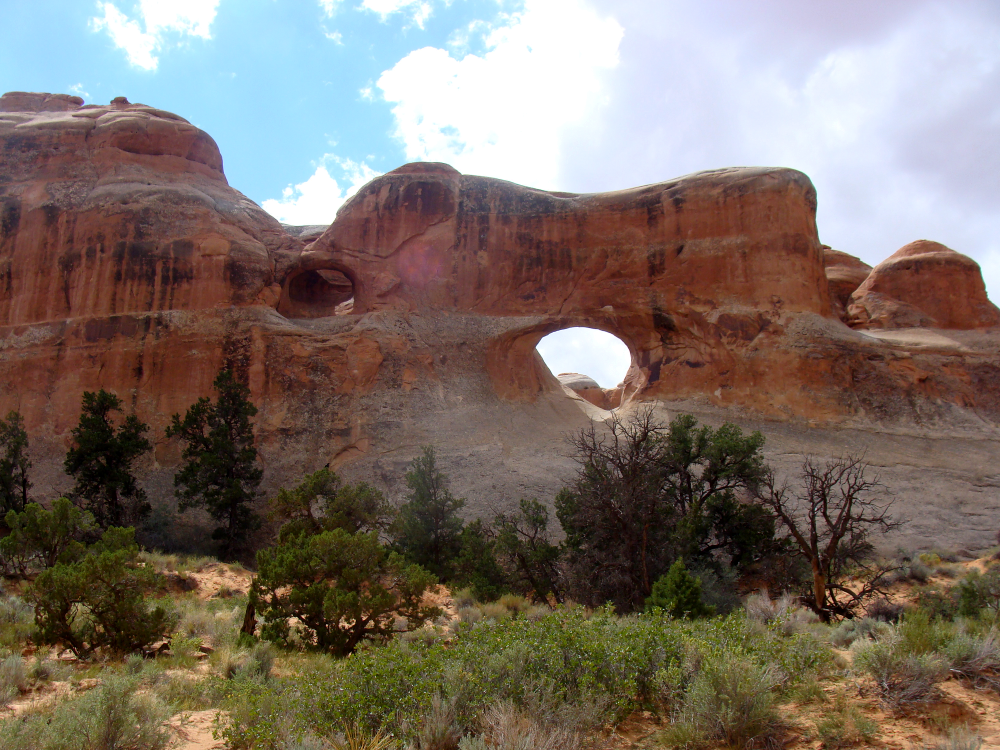
The next day we visited Arches National Park for the first time. Iconic for its incredible sandstone formations, particularly its astonishing natural arches as seen on calendars, desktops, and in stock photo archives everywhere, Arches is somehow so overexposed that it's hard to grasp the enormity of the intricate geological processes that bring these arcing sculptures to life. Here we stand, in the limelight of this sandstone's heyday, when millions of years of erosion have unlocked thousands of free standing arches for a brief eon of existence before they erode away like so much stone before them.


Even as a degree-holding geologist I have a hard time truly processing the cornucopia of factors that allow the arches to stand today. First you need to put a hefty deposit of porous sandstone on top of a denser, clayey layer that is already on top of a thick, salty layer, preferably left behind by an ancient ocean. Then you need the sediment on top of the salt to be just heavy enough that the salt liquefies, buckles, and causes uplift. You need this uplift to crack the uppermost sandstone layer; in this case that layer is the Entrada sandstone formation and the medium for most of the park's arches.

Once the Entrada sandstone cracks, you must wait a million years or more for just the right amount of rain to fall, eroding the cracks into deep yet narrow valleys. You need just the right amount of water to gather at the crux between the Entrada formation and the denser layer beneath. These puddles have to create cavities by dissolving the sandstone into loose particles and allowing it to be washed or blown away. One fine day, these cavities will become the famous gaps in the arches. But don't wait too long, because left to nature's erosional ways, the precariously crafted aches will eventually be washed of their cement and turned to dust too.


So you are here, on just the right day in not only your whole life, but in all of geologic history, to see these delicate arches stand - fragility and temporality encased in the feigned permanence of stone. Because without a doubt the arches will be gone one day, and perhaps that day might will tomorrow. Mother Nature can be a bitch like that. But I suppose she's an even more impressive as an artist, for who knows what other epic earth sculptures she has locked away and waiting for another million years or so to release.

After the mindfuck that is Arches, we hit the highway west for a less surreal landscape - at first glance. Fishlake National Forest may not carry the same shock and awe power that Arches does, but a glimpse underneath the soil tells a different story. What might be mistaken for just another forest thick with quaking aspen (Populus tremuloides) is actually an organism oft touted as the oldest, largest, and heaviest on the planet. Can you guess what colossus lives in this Southeast Utah forest? Why, it's Pando, of course, and he is the forest! Pando is actually 160 acres of clonal quaking aspen, believed to be at least 80,000 years old and weighing upwards of 13 million pounds.


You might be wondering how one tree can be multiple organisms weighing millions of pounds, but all you have to know is that Pando isn't just one tree, he is all of the trees. He thrives from a singularly dense system of roots from which he sends up suckers that turn into saplings with the same biological and molecular make up as the trees from whose roots they sprang. Multiply this process by 80,000 years, maybe more, and you have a forest full of genetic clones all a part of the same root body: Pando, which translates from Latin into "I spread".


Scientists believe that Pando is the vestigial remains of an ecosystem from a much warmer climate and that due to unfavorable present day conditions, Pando hasn't flowered for 10,000 years. And whether this data translates into chilly September nights, I don't know, but Nessa and I surely found it difficult to do most things that brisk evening, including build a fire, which we failed miserably at. Damned damp Pando wood!! Though I suppose that's what you get when you road trip in September at 8,800 feet above sea level. So we woke up a little cranky the next morning, arguing over who was pushing who into which puddle of freezing water pooling into the tent while sleeping, but like the intrepid travelers that we are, eagerly hit the road to lower elevations.


Actually, that isn't to be continued because I already posted my ode to that paranormal highway. So read it next and then stay tuned for a little ditty I like to call "Morning Over Mono".

October 18, 2014

5: Swans-a-Swimming


Actually, it was more like ten swans-a-swimming. And to get even more technical, it was a Mute Swan mom and dad plus their very impressive brood of eight teenagers. So cute! Would you believe that this little familial unit lives in right in the heart of Boston, Massachusetts? 

These ten swans are very tenderly cared for by the man whose pond they live in. It's actually a really small pond, so he supplements their diet when the algae becomes thin and he even goes so far as to feed the resident snapping turtles as well so they don't become tempted to eat the cygnets in their vulnerable stages. And so eight healthy adult swans will enter the urban ecosystem because of him. That's love.

One
Mute Swans and are considered an exotic and introduced species to North America.

Two

Swans mate for life.

Three
This swan is "busking", which means that it is adopting a defensive stance with wings half-raised and hissing at me to go away so his family can eat peacefully.

Four

Mute Swans are known for being quieter than other species of swans. They whistle, snort, and grunt to communicate.

Five
Swans are very aggressive. They have knobby spurs in their wings called cobs which they will use to attack and defend their territory.

Bonus
Because swans are really epic creatures and when you see ten of them all together you can't stop taking pictures.